
The internet has become an essential part of everyday life, connecting billions of devices across the world. Activities such as browsing websites, sending emails, watching videos, using online banking, and accessing cloud services are possible because of a hidden system that manages communication between devices. This system is based on internet protocols.
Internet protocols are a set of rules that allow computers, smartphones, servers, and other devices to exchange information correctly. They define how data is created, transferred, received, and understood between connected devices.
Without internet protocols, different devices and networks would not be able to communicate with each other. These protocols work in the background to ensure that information reaches the correct destination quickly, securely, and accurately.
What Are Internet Protocols?
Internet protocols are standard communication rules used by devices connected to a network. They decide how data should be formatted, addressed, transmitted, and delivered from one device to another.
When a user visits a website or sends a message, multiple protocols work together to complete the process. These protocols help devices understand where information needs to go and how it should be processed.
Just like people use a common language to communicate, computers use internet protocols to exchange information. These rules make global communication possible by allowing different systems and technologies to work together.
Why Internet Protocols Are Important
Internet protocols are the foundation of internet communication. They ensure that billions of devices connected through different networks can exchange data without confusion.
Protocols help identify devices, manage data transfer, improve communication speed, and maintain security. They also allow different types of hardware and software systems to communicate effectively.
For example, when someone opens a website, protocols help locate the website server, request the required information, transfer the data, and display the webpage on the user’s device.
Without these protocols, online services and digital communication would not function properly.
How Internet Communication Works
When information is sent through the internet, it is not transferred as one large file. Instead, data is divided into smaller units called packets. Each packet contains a portion of the information along with details about its destination.
These packets travel through different networks and routers before reaching their final destination. Once they arrive, the receiving device collects and reorganizes them to recreate the original information.
This entire process happens within seconds and allows users to access online content almost instantly.
Understanding the TCP/IP Model
The TCP/IP model is the basic framework that controls internet communication. It consists of different layers that work together to ensure reliable data exchange.
The Internet Protocol (IP) manages the addressing and routing of data packets. Every device connected to the internet has an IP address that helps identify its location on the network. IP ensures that data reaches the correct destination.
The Transmission Control Protocol (TCP) focuses on reliable delivery. It checks whether data packets arrive correctly and requests missing information if necessary. This ensures accurate communication during activities such as website browsing, file sharing, and email exchange.
Together, TCP and IP create the foundation of modern internet communication.
How HTTP and HTTPS Work
HTTP, or Hypertext Transfer Protocol, is one of the most commonly used internet protocols. It allows communication between web browsers and website servers.
When a user enters a website address, HTTP helps the browser request information from the server. The server then sends the required webpage data back to the browser.
HTTPS is the secure version of HTTP. It uses encryption to protect information exchanged between users and websites. This security feature is especially important for websites involving sensitive information such as online payments, personal accounts, and private data.
Role of DNS in Internet Communication
The Domain Name System (DNS) works like an address system for the internet. Humans usually remember website names, while computers identify locations using IP addresses.
DNS converts website names into IP addresses so browsers can find the correct servers.
For example, when a user enters a website name, DNS quickly identifies the related server location and helps establish a connection. Without DNS, users would need to remember complex numerical IP addresses for every website.
How FTP and Email Protocols Work
File Transfer Protocol (FTP) is used for transferring files between computers and servers. It allows users to upload and download files through a network connection.
Email communication also depends on specific protocols. Simple Mail Transfer Protocol (SMTP) is responsible for sending emails from one system to another. Other email protocols help users receive and manage messages.
These protocols ensure that digital communication and file sharing happen smoothly across networks.
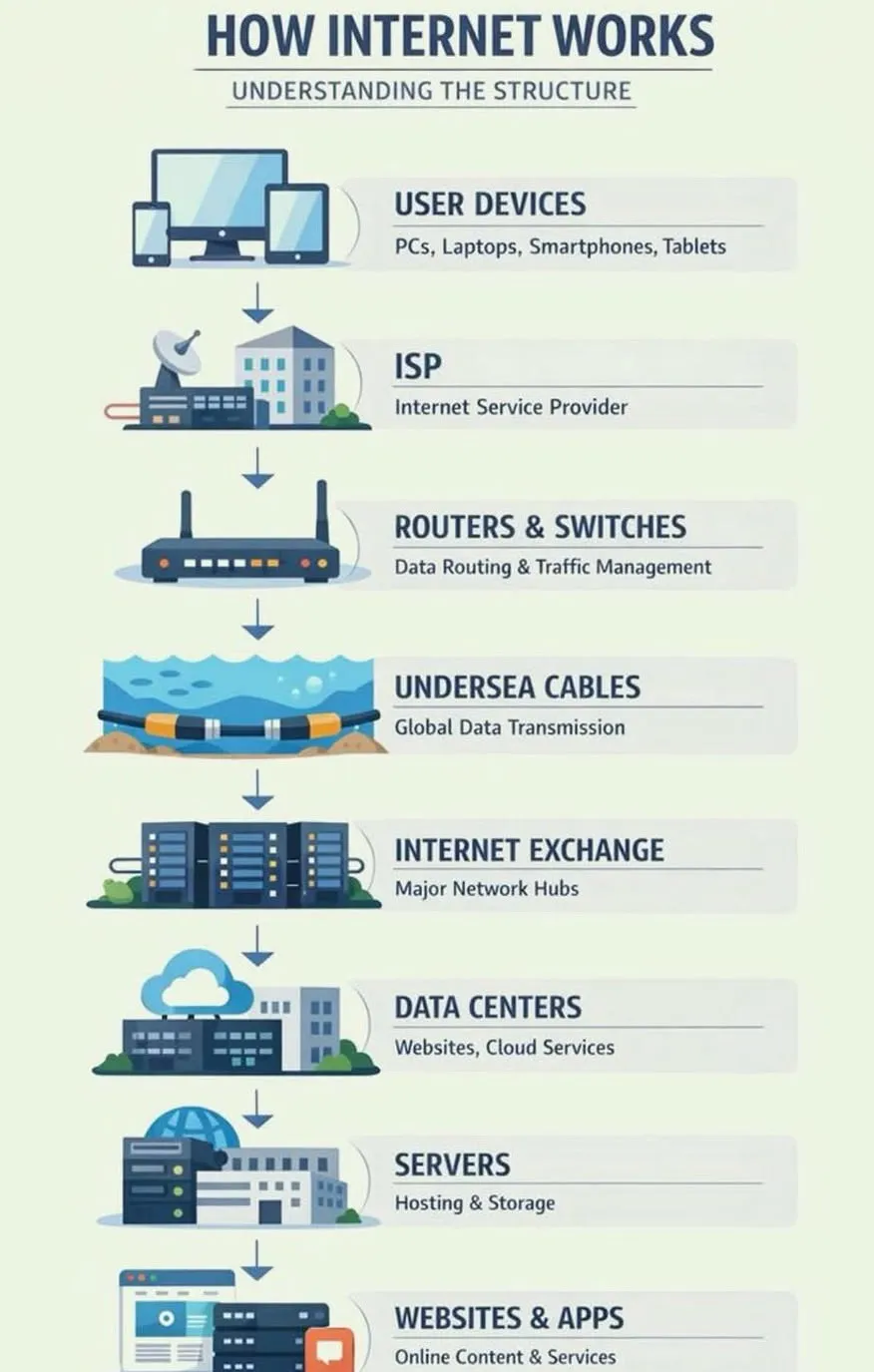
Role of Routers and Servers
Routers and servers play an important role in internet communication. Routers act as traffic managers that analyze data packets and choose the best path for sending information.
Servers store websites, applications, databases, and online services. When users request information, servers respond by sending the required data through internet connections.
Protocols guide communication between users, routers, and servers to ensure that information reaches the correct destination.
How Internet Protocols Support Daily Online Activities
Almost every online activity depends on internet protocols. When people stream videos, send messages, shop online, or use cloud applications, different protocols work together behind the scenes.
For example, video streaming requires protocols that manage large amounts of data transfer. Online banking uses secure communication protocols to protect financial information. Cloud services depend on protocols to provide access to stored files and applications from different locations.
These systems make digital experiences faster, safer, and more reliable.
Internet Protocols and Security
Security has become a major part of modern internet communication. As cyber threats increase, protocols are designed with stronger protection methods to keep data safe.
Encryption helps prevent unauthorized access to information, while authentication systems verify the identity of users and devices.
Secure protocols protect personal information, financial details, and business data from cyber risks. However, users must also follow security practices such as using strong passwords and updating software regularly.
IPv4 and IPv6: Evolution of Internet Addresses
Internet Protocol addresses have evolved as the number of connected devices has increased.
IPv4 was the original addressing system used for internet communication. However, the rapid growth of smartphones, smart devices, and online services created a need for more addresses.
IPv6 was developed to provide a much larger number of unique addresses and support future internet expansion. It also includes improvements that help modern networks operate more efficiently.
The transition from IPv4 to IPv6 ensures that the internet can continue growing with increasing numbers of connected devices.
Future of Internet Protocols
The future of internet protocols will be influenced by emerging technologies such as artificial intelligence, cloud computing, smart devices, and the Internet of Things.
As more devices become connected, protocols will need to become faster, more secure, and more efficient. Future developments will focus on improving communication speed, reducing delays, and providing better protection against cyber threats.
Advanced networking technologies will continue improving how people and machines communicate around the world.
Conclusion
Internet protocols are the backbone of modern digital communication. They provide the rules that allow billions of devices to exchange information accurately and securely.
From TCP/IP and DNS to HTTP, HTTPS, and other communication systems, every protocol performs an important role in making the internet work smoothly.
Although users rarely notice these technologies, they operate behind almost every online activity. Understanding internet protocols helps beginners better understand the technology that powers the digital world and explains how global internet communication is possible.