
Cannons roar across the Caribbean as Captain Jack Sparrow’s crew aboard the Interceptor trades fire with the Black Pearl. In the chaos, a fork flies across the deck, knocks a wooden eye clean out of a pirate’s socket and sends it rolling. The one-eyed man scrambles after it. The scene is pure Hollywood spectacle, and it reinforces a familiar image: the pirate with an eyepatch, missing an eye, battle-scarred and menacing.
Yet the real story behind the eyepatch is more interesting than simple injury. A combination of vision science, a well-known television experiment and a university study points to a practical reason that films rarely explore. At the same time, historical records offer little proof that Golden Age pirates actually used the device that way.
The Hollywood Pirate and the Missing Eye
Popular culture has long linked pirates with eyepatches, peg legs and hooks. Robert Louis Stevenson’s Treasure Island helped fix the image in the public mind through the character of Long John Silver. Later films and stories amplified it. The patch became visual shorthand for a life of violence at sea: an eye lost to a sword, a splintered spar or a musket ball.
That explanation is straightforward and emotionally satisfying. Life aboard wooden ships was dangerous. Injury rates were high. Covering a damaged or missing eye would have been a practical response to trauma and infection risk. Some real sailors and privateers did lose eyes to combat or disease. Yet the leap from occasional injury to a defining pirate accessory is largely a creation of fiction rather than a reflection of surviving historical descriptions.
The Science of Switching Between Light and Dark
Human vision does not switch instantly between bright sunlight and deep shadow. In bright light, the photopigment rhodopsin in the rod cells of the retina is largely bleached. Restoring full sensitivity in darkness requires time—often 20 to 30 minutes or more for complete dark adaptation. During that period a person is effectively half-blind in low light.
A ship in the age of sail constantly moved its crew between the glare of the open deck and the relative gloom below. Lanterns and hatches provided some illumination, but the contrast remained sharp. Anyone descending into a hold or cabin after prolonged exposure to sunlight would need minutes to regain useful vision—minutes that could matter in a fight, a chase or an emergency.
Covering one eye with a patch keeps that eye in continuous darkness. Its rhodopsin remains unbleached and its rods stay primed. When the wearer moves into a dark space, simply shifting or removing the patch allows the pre-adapted eye to take over immediately. The brain can rely on the ready eye while the other begins its slower adjustment. The principle is sound physiology. Pilots and military personnel have long recognised similar techniques for preserving night vision in one eye.
What the Experiments Showed
In 2007 the television programme MythBusters tested the idea. One participant had one eye covered while the other was exposed to bright light. When both eyes were then tested in darkness, the previously covered eye adapted far more quickly and provided usable vision sooner. The team judged the pirate-patch hypothesis plausible on scientific grounds.
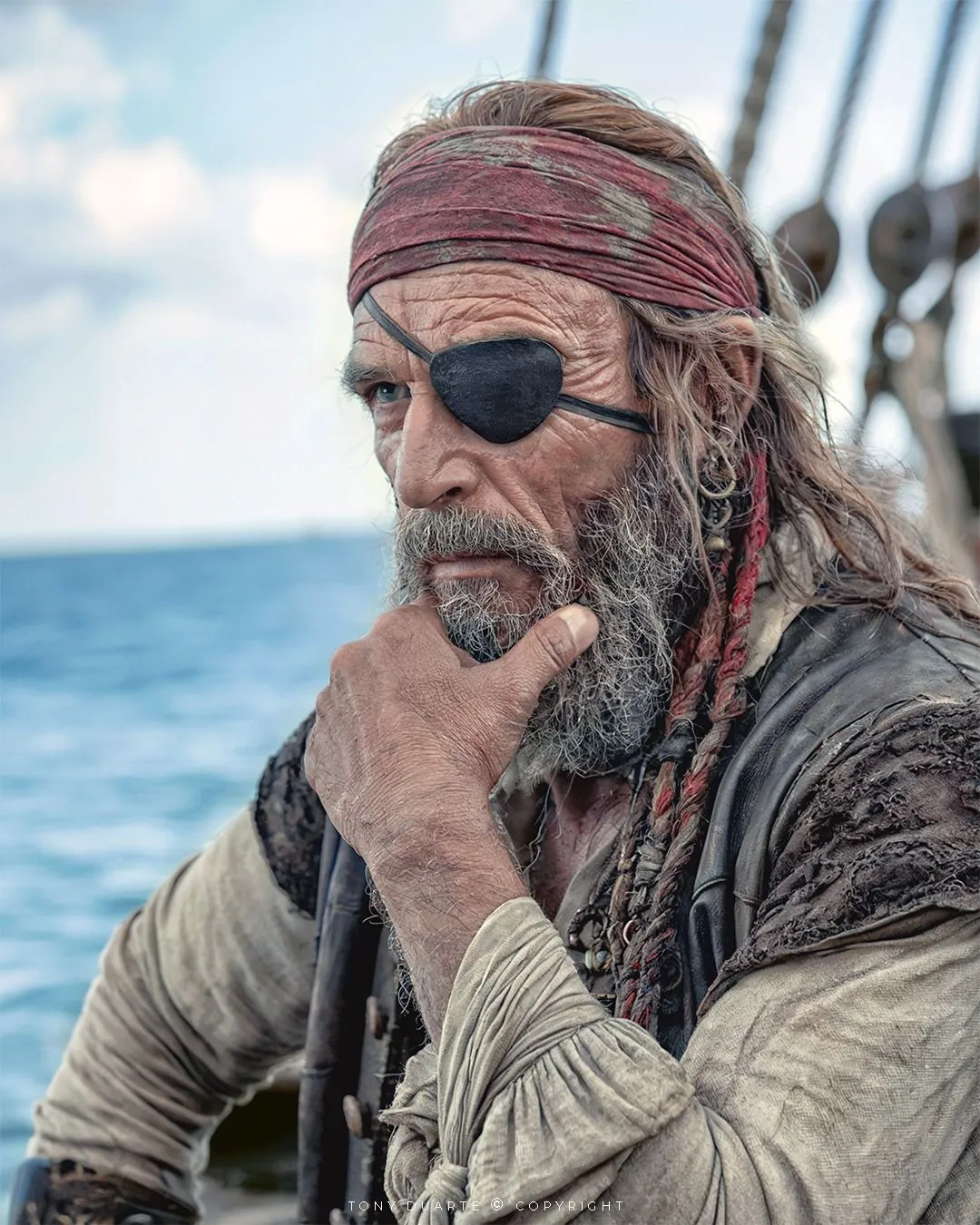
A later student-led study at the University of St. Thomas in Minnesota took the question into a controlled setting. Approximately 70 undergraduates took part. Half wore an eyepatch for 20 minutes beforehand. All participants were then blindfolded, led into a completely dark room and asked to locate a table, complete a simple puzzle and find the exit. Those who had worn the patch completed the tasks markedly faster. Researchers also recorded a noticeable drop in cortisol, a stress hormone, among the patched group after the exercise. The work was presented at a psychology conference and offered as supporting evidence rather than a definitive clinical trial, but the performance difference was clear.
Together the demonstrations confirm that the optical strategy works. A covered eye really does stay ready for darkness.
The Historical Silence
Science, however, is not the same as history. Pirate historians examining primary sources from the seventeenth and eighteenth centuries—logs, court records, woodcuts, eyewitness accounts and contemporary illustrations—find almost no evidence that pirates routinely wore eyepatches. There are no naval manuals recommending the practice, no repeated descriptions of crews using patches for tactical advantage, and few images that match the Hollywood stereotype.
Where an eyepatch appears in the historical record, the more economical explanation is injury. An empty socket or a damaged eye would naturally be covered. The absence of widespread documentation suggests that the night-vision tactic, while clever and physiologically effective, was not a standard piece of pirate equipment. Below-deck spaces were rarely pitch black; portholes, hatches and lanterns provided residual light. The dramatic total darkness assumed in the popular theory may overstate the actual conditions.
The enduring image of the patched pirate therefore owes more to literature and cinema than to the archives of the Golden Age of Piracy.
What the Evidence Leaves Us With
Two truths sit side by side. First, the human visual system adapts slowly to darkness, and keeping one eye covered is a genuine way to preserve that adaptation. Experiments conducted more than a decade apart have shown measurable benefits in speed and performance. Second, there is scant historical support for the claim that pirates systematically used eyepatches for this purpose. The device, when worn at all, more likely covered a wound.
Hollywood prefers the dramatic version: the one-eyed rogue, the wooden eye rolling across the deck, the patch as badge of battles survived. The quieter scientific story—an eye deliberately kept in darkness so that a sailor could see the moment he stepped below—is less cinematic but more revealing about how vision actually works. The next time a film pirate adjusts his patch before descending a companionway, it is worth remembering the retina underneath and the minutes of adaptation it might have saved. Whether any real pirate ever thought of it that way remains an open question the records have yet to answer.
Read more – Penalcodedetail.com